

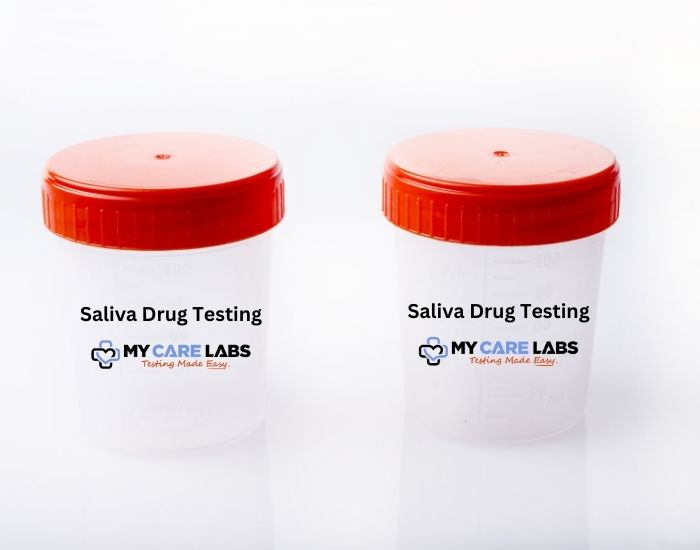
Drug testing plays a pivotal role in various contexts, such as employment screening, criminal justice proceedings, or healthcare diagnosis. Though there are different methods available, urine and saliva drug testing are two of the most commonly used approaches. These methods provide advantages and limitations, making them suitable for specific situations. Today, we will discuss the main differences between urine and saliva drug testing, mainly on their mechanisms, time frame windows, accuracy, and practicality. Additionally, we will discuss the new testing services My Care Labs, located in Fremont, Ca, will begin offering in the coming weeks.
Mechanisms and Detection Windows
Urine Drug Testing:
Urine drug testing, also known as urinalysis, is a well-established method that detects the presence of drugs and their metabolites in a person’s urine. This method relies on the fact that drugs and their breakdown products are passed through the urinary system. Urine testing can detect a wide range of substances, including illicit drugs, prescription medications, and their metabolites. The time frame window for urine drug testing is relatively longer compared to saliva testing, typically ranging from a few days to several weeks, depending on factors such as the time it takes for the amount of said drug to be reduced by half the intake amount and the individual’s metabolism. However, it’s important to note that urine tests might not be as effective in detecting recent drug use, as some drugs are quickly eliminated from the body.
Saliva Drug Testing:
Saliva drug testing, also called oral fluid testing, involves analyzing a person’s saliva for the presence of drugs and their metabolites. This method searches for substances that are actively circulating in the bloodstream and have been secreted into the oral cavity. Saliva tests are particularly effective for detecting recent drug use, as the time frame window is generally shorter compared to urine tests. Substances like cannabis, for example, can be detected in saliva within a few hours of use and up to 1-2 days in some cases. However, the detection window for saliva testing is generally limited to a few days for most drugs, making it less suitable for identifying long-term drug use.
Accuracy and Reliability
Urine Drug Testing:
Urine drug testing is acclaimed for its widespread use and generally reliable results. It has a relatively low potential for false positives and false negatives, given that the collection and testing procedures are collected and conducted correctly of course. However, it’s important to consider the potential for adulteration or substitution of urine samples, as individuals may try to manipulate the results by diluting their urine or using synthetic urine products. Laboratories have implemented measures to detect such tampering, but it continues to remain a concern.
Beginning on September 15, My Care Labs headquarters in Fremont, will be offering toxicology testing. We will be conducting drug testing by offering urine tests to inquiring employers and other individuals.
Saliva Drug Testing:
Saliva drug testing offers the advantage of being less invasive and easier to administer than urine tests. It reduces the possibility of sample tampering, as the collection process can be observed directly. However, the accuracy of saliva tests can be influenced by factors such as the individual’s oral hygiene, the presence of certain medications, and the type of drug that is being tested for. While the risk of adulteration is lower compared to urine tests, there can be instances where the concentration of drugs in saliva is too low to be detected accurately, leading to false negatives.
Practical Implications
Urine Drug Testing:
Urine drug testing is often used in various settings, including workplace drug testing programs and probation monitoring. It is especially valuable for identifying long-term drug use patterns and previous substance abuse. Due to its longer detection window, urine testing is suitable for scenarios where the timeframe of drug use is not restricted to recent occurrences. However, the need for private restroom facilities during the sample collection and the potential for evading the patient’s privacy remain as challenges.
Saliva Drug Testing:
Saliva drug testing has gained popularity in recent years, particularly in situations where detecting recent drug use is crucial. It is commonly used in roadside testing for impaired driving and in situations where immediate results are required. Its non-invasive nature and shorter detection window make it an appealing option for various contexts. However, its effectiveness diminishes for detecting historical drug use, making it less suitable for scenarios that require a broader perspective on an individual’s drug history.
Conclusion
In summary, both urine and saliva drug testing methods have their unique strengths and limitations. Urine testing offers a longer detection window and is effective for identifying historical drug use, while saliva testing excels in detecting recent drug use with its non-invasive and convenient collection process. The choice between the two methods depends on the specific goals of the testing program, the timeframe of interest, and the desired level of accuracy. Regardless of the method chosen, it is crucial to follow proper collection and testing protocols to ensure reliable and actionable results.
Beginning on September 15, 2023, My Care Labs, our Fremont location, will be offering toxicology and wellness testing in addition to our Covid-19 services. Our medical professionals will be utilizing the urine sample method for our toxicology practices. These new services the proactive new hires or possible court mandated reasons. Additionally, My Care Labs’ wellness testing will be offering blood tests for patients concerned about their cholesterol, for example. Whatever your health concerns may be, Covid-19 related or employer mandated, My Care Labs is here to make your lives easier.
Sources:
- “Urine Drug Testing” – Lab Tests Online. https://labtestsonline.org/tests/urine-drug-testing
- “Saliva Drug Testing” – Confirm BioSciences. https://www.confirmbiosciences.com/knowledge/drug-testing/saliva-drug-testing/
- “Oral Fluid Drug Testing” – Substance Abuse and Mental Health Services Administration (SAMHSA). https://www.samhsa.gov/workplace/resources/drug-testing/oral-fluid
- Cone, E. J., & Huestis, M. A. (2007). Interpretation of oral fluid tests for drugs of abuse. The Annals of Pharmacotherapy, 41(7-8), 1215-1222. https://journals.sagepub.com/doi/abs/10.1345/aph.1H664
- “Urine vs. Saliva Drug Testing: Which Is More Effective?” – TestCountry. https://www.testcountry.com/blogs/drug-testing/urine-vs-saliva-drug-testing-which-is-more-effective



One Response
Best Home blood testing Company .